The qilin is one of the most auspicious creatures in Chinese mythology, associated with benevolence, good fortune, wise leadership, and the arrival of an exceptional person. It is often described as a gentle, composite animal with features drawn from creatures such as the deer and dragon, although its appearance changes across works of art and historical periods. At Museum PBC, these ideas come into focus through the Ch’i-Lin Box, a 45 centimetre wooden object decorated with pigments and gold leaf. Its form brings Chinese mythological imagery together with a Balinese floral design, offering a useful starting point for understanding how symbols travel between cultures.
The qilin, written 麒麟 in Chinese, is a legendary creature rather than an animal that belongs to the natural world. Its English descriptions sometimes compare it with a unicorn, but that comparison can be misleading because the qilin does not have one fixed shape. In Chinese art, it may combine a head resembling a dragon, horns, scales, a body resembling a deer or horse, cloven hooves, and a tail like an ox. The Cleveland Museum of Art explains that historical descriptions vary, which is why depictions can look quite different from one another.
More important than its anatomy is what the creature represents. The qilin is often portrayed as gentle and benevolent, a being that does not use its strength to harm others. It is linked with virtue, mercy, peace, and the hope that society is being guided by a wise ruler. Rather than representing power through fear, it suggests power guided by moral responsibility.
The qilin is also known as an auspicious sign. In traditional stories, its appearance can announce a period of peace or the arrival of a sage whose life will matter to the wider world. Some legends connect the creature with Confucius, including a story in which a qilin appears to his mother before his birth. These accounts are mythology, not documented events, but they help explain why the qilin became associated with wisdom, good fortune, and exceptional potential.
The qilin has a long literary history. The Cleveland Museum of Art identifies the Book of Songs, a collection of poems generally dated between the eleventh and seventh centuries BCE, as probably the earliest surviving text to mention the creature. In the poem, the qilin’s hoof, brow, and horn are described as powerful, yet the animal is not violent. The poem connects the creature with noble character and the kin of a worthy ruler, reinforcing the idea that true strength can exist alongside restraint.
Later Chinese texts developed the qilin’s symbolic role. A description associated with the Han dynasty presents it as an animal of mercy, with the body of a deer, the tail of an ox, and a single horn. Other accounts connect its appearance with the presence of a sage or a ruler whose conduct brings harmony. Because no single description became universal, artists had room to adapt the creature to the material, setting, and message of each object.
The qilin also entered the language of imperial status. During the Ming dynasty, its image appeared on rank badges associated with nobles, and during the Qing period it became the insignia of the highest rank of military officials. The Metropolitan Museum of Art explains that the qilin’s association with a virtuous ruler gave the image political meaning as well as decorative appeal. A creature that signalled good governance could communicate an ideal of authority without relying on a portrait of a specific ruler.
One unusual episode shows how powerful the symbol could be. In 1414, a giraffe presented to the Ming court was interpreted as a qilin, even though a giraffe was a real animal unfamiliar to many people in China at the time. Court officials celebrated the arrival as an auspicious sign that supported the emperor’s legitimacy. The episode illustrates how the qilin was not simply a fantasy creature but also a symbol through which people interpreted events and expressed political hopes.
Over time, the qilin became a popular motif on objects made for everyday life, celebration, and important family occasions. Its meaning could include prosperity, protection, longevity, fertility, and success, although the emphasis changed depending on the object and its context. The Asian Art Museum documents qilin figures associated with wishes for a distinguished son, scholarly achievement, and honour for a family. These meanings made the creature suitable for gifts, decorative objects, and items displayed in a household.
A qilin carrying a book, for example, could express the hope that a child would grow into a learned and accomplished person. Other depictions place a child on the qilin’s back, connecting the creature with family continuity and the wish for descendants. The image was therefore not limited to one religious or political meaning. It could express hopes for a household, a child, a leader, or a community.
The symbolism should still be read with care. Not every qilin image promises the same thing, and the presence of the creature does not prove that an object was used in a particular ceremony. It is more accurate to say that the qilin carries a broad language of auspicious wishes, with its specific meaning shaped by the object’s form, decoration, owner, and setting.
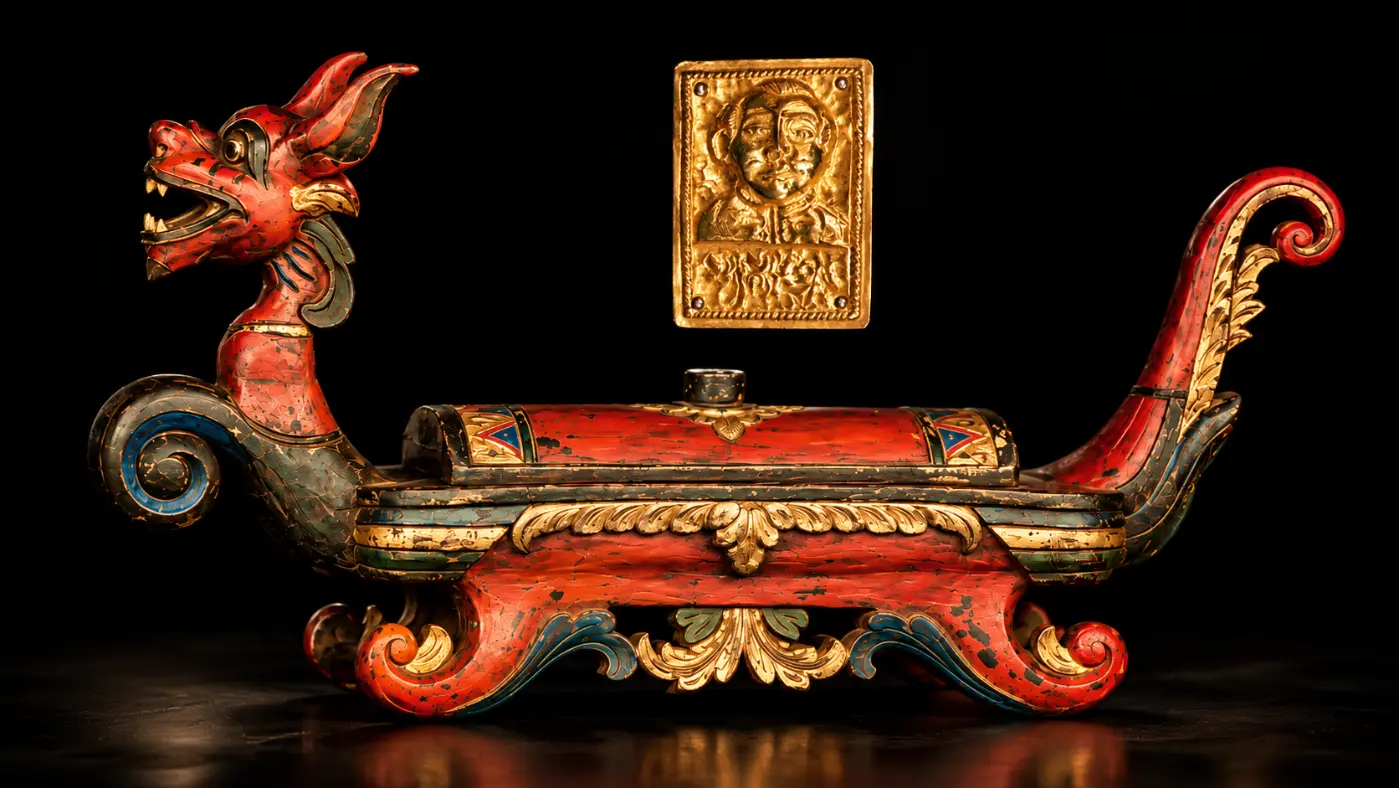
The Ch’i-Lin Box at Museum PBC gives this mythology a physical form. The museum label identifies the object as being made from wood, pigments, and gold leaf, with a length of 45 centimetres. It describes the qilin as a Chinese mythological creature associated with fertility, prosperity, success, protection, and longevity. The label also records that the object was a gift to the parents of Ong The-Nio, also known as Sang Nio, in Badung.
The box is especially interesting because the qilin is not simply painted onto a flat surface. The creature forms the shape of the object, with a long body, curled ends, a raised head, and decorative details that make it appear lively and protective. Its red, blue, green, and gold colours give the carving a vivid presence, while the animal’s posture turns a functional container into an object with symbolic meaning. The result is both a storage piece and a display of auspicious imagery.
According to the museum label, the qilin’s back includes a knob surrounded by a Balinese floral design, with decorated ends forming the lid for a storage space. That detail makes the object more than an illustration of Chinese mythology. It shows how a familiar mythical figure can be adapted to a particular decorative tradition and incorporated into a useful object.
Look first at the creature’s head and body. The raised head, open mouth, curved horns or crest, and patterned details recall the imaginative visual language used for qilin figures in Chinese art. The exact anatomy does not need to match one canonical model to make the identification meaningful. Historical depictions of the qilin vary, and artists often adjusted the creature to fit the design of a textile, sculpture, box, or architectural ornament.
The colour and surface decoration also matter. Red and gold are frequently used in Chinese decorative arts for festive and auspicious objects, while blue, green, and other pigments can add contrast and highlight carved forms. In this box, the gold leaf draws attention to the details and gives the creature a ceremonial presence. These visual choices support the positive associations described on the museum label, although they do not by themselves establish the date, workshop, or precise occasion for which the box was made.
The lid is a particularly thoughtful feature. Because the storage space is integrated into the qilin’s back, the mythical creature becomes part of the object’s practical design rather than a separate ornament. The box asks viewers to consider how symbolism can be built into everyday belongings. It is a reminder that historic objects can carry meaning through both their appearance and their use.
The Ch’i-Lin Box is also a starting point for thinking about the long relationship between Chinese and Balinese visual culture. Research on Chinese cultural elements in Bali describes exchanges that developed over centuries and notes that Chinese motifs have been incorporated into Balinese society, art, religious life, and everyday practices. This process is not simply a matter of copying an image from one place to another. Motifs can be reshaped to fit local aesthetics, materials, beliefs, and social settings.
A related study published in the Bali Tourism Journal discusses how shared histories have influenced architecture, ornaments, rituals, and artistic expression. Such research provides a useful context for viewing an object that combines a Chinese mythological creature with a floral design identified by Museum PBC as Balinese. The box can be understood as an example of visual exchange, while still leaving room for questions about who made it and under what circumstances.
It is important not to assume that every object featuring a qilin was made in China. Mythological imagery can travel through trade, migration, family relationships, collecting, and artistic adaptation. The Museum PBC label provides specific information about the materials, dimensions, decoration, and gift association, but it does not state the maker or date. For that reason, the most careful description is a box featuring Chinese qilin imagery and Balinese decorative elements, rather than a definitively Chinese made object.
The museum label connects the box with the parents of Ong The-Nio, also known as Sang Nio, in Badung. This detail gives the object a personal and local point of reference beyond the general history of Chinese mythology. It suggests that the box was associated with a particular family and circulated as a gift, although the available label does not explain the date, occasion, or relationship between the people involved. Those details should not be filled in without further documentation.
The gift association is still meaningful because auspicious objects often communicate wishes that are difficult to express through words alone. A qilin motif could convey hopes for protection, prosperity, longevity, family well being, or future success. The exact intention behind this particular gift remains uncertain, but the symbolism helps explain why such an image could be appropriate for a household object given to a family.
This is where the box connects mythology with lived experience. A legendary creature becomes part of an object that could be handled, stored, displayed, and passed between people. Its story is not only about ancient texts or imperial symbolism, but also about the ways families used visual language to express care and good wishes.
When viewing the Ch’i-Lin Box, begin by noticing the relationship between its form and function. Look at how the creature’s body supports the lid, how the knob is integrated into the decoration, and how the colours draw attention to the carving. Then consider the meanings associated with the qilin, including benevolence, good fortune, protection, and family prosperity. Reading these details together offers a richer experience than identifying the creature alone.
It is also worth separating what is documented from what remains uncertain. The museum label supplies the object’s name, materials, size, a short explanation of the qilin, the Balinese floral design, and its association with the parents of Ong The-Nio in Badung. It does not give a confirmed date, maker, or full provenance history. Recognising those limits is part of responsible museum interpretation, because it keeps the object’s known history distinct from attractive but unverified stories.
The qilin remains compelling because it brings together ideas that people continue to value, including kindness, wisdom, family well being, and hope for a peaceful future. At Museum PBC, the Ch’i-Lin Box offers a tangible way to consider how these beliefs were expressed through decorative art and adapted within Bali’s cultural setting. To see how this object sits alongside other stories of Indonesian and Asian art, visit the Museum PBC collection and review the museum’s visitor information before planning your visit.