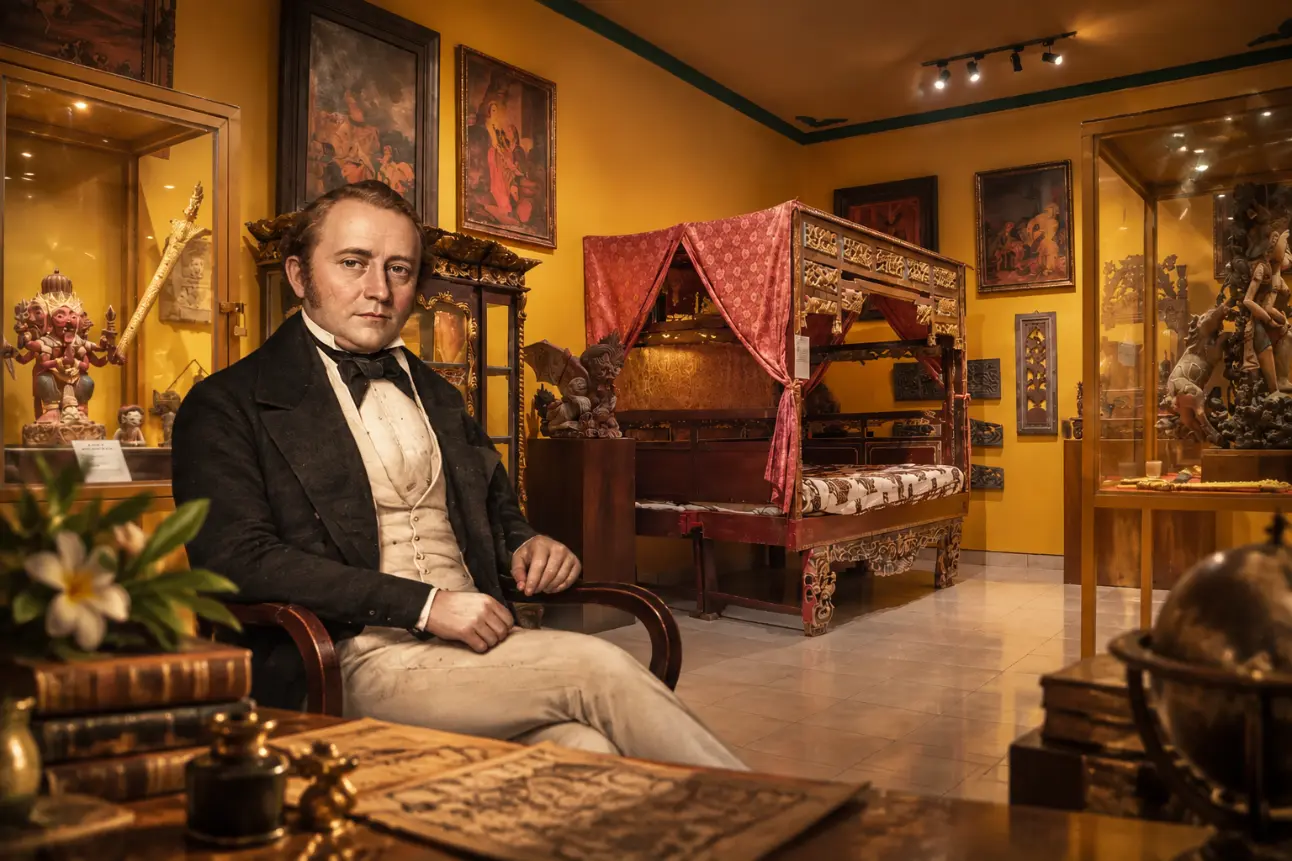
Long before Bali became known as a global tourism destination, the island was already connected to international networks through trade, diplomacy, and cultural exchange. During this period, a man from a small island in Denmark arrived in Southeast Asia and became deeply connected with the history of Bali. His name was Mads Johansen Lange.
The story of Mads Lange is not only about where he came from, but also about how a foreign trader could build relationships with local communities and gain the trust of Balinese rulers. His journey reflects a remarkable encounter between different cultures, economies, and traditions.
Lange became known as a person who connected different worlds. He linked European trading networks with local Balinese commerce, created relationships with royal courts, and became an intermediary between the Balinese kingdoms and Dutch colonial authorities.
Mads Johansen Lange was born in 1807 in Rudkøbing, a small town on the island of Langeland, Denmark. Growing up in a maritime environment shaped his understanding of navigation, trade, and international connections.
At a young age, Lange left Denmark and began a journey across the seas. His travels eventually brought him to Southeast Asia, where he discovered opportunities beyond the familiar world of Europe. The Indonesian archipelago became more than a temporary destination. It became the place where he built his career, relationships, and legacy.
One interesting fact about Lange is that although he spent most of his adult life far away from Denmark, he maintained a connection with his homeland. His achievements in the East were recognized in Denmark, showing that his influence reached beyond the boundaries of Bali.
Before establishing his presence in Bali, Lange developed his trading activities in Lombok. Through his experiences there, he gained a deeper understanding of regional commerce and the importance of building trust with local communities.
Trade during the nineteenth century was not only about exchanging goods. It depended on relationships, cultural understanding, and the ability to communicate across different societies. These qualities later became essential when Lange arrived in Bali.
His success came not only from business skills, but also from his ability to navigate between different cultures and social systems.
Around the late 1830s, Mads Lange settled in Kuta, located on the southern coast of Bali. At that time, Kuta was not yet the international tourist destination known today. It was a strategic coastal area connected to maritime trade routes.
In Bali, Lange was not simply seen as a foreign merchant. He developed close relationships with local communities and the royal family of Badung. His understanding of Balinese customs and his ability to communicate with different groups allowed him to become a trusted figure in the region.
His position became even more significant as relations between Balinese kingdoms and Dutch colonial authorities became increasingly complex. Lange often acted as a mediator between different interests, creating a unique position for himself within Bali’s political and economic landscape.
Because of his influence and connections, he became known by the nickname “King of Bali.” The title did not mean that he was a formal ruler of the island. Instead, it reflected the level of respect and influence he had gained through trade, diplomacy, and relationships.
The story of Mads Lange is not only about wealth, business, or political connections. Behind the famous nickname was a person who created a life in Bali and became part of the community around him.
He was a businessman who connected Bali with international markets. He was also a mediator who understood the interests of different groups. More importantly, he was an individual who lived between cultures and created meaningful relationships in a place far from his birthplace.
His story shows that history is often shaped by encounters between people from different backgrounds. A person does not become part of a place only through origin, but also through the connections they create and the impact they leave behind.
At Museum PBC, the story of Mads Lange is presented not only through major historical events but also through a more personal perspective.
The Mads Lange Bedroom offers visitors a closer look at the private side of this historical figure. The room is presented as a reconstruction of Lange’s personal space, with its centerpiece being a nineteenth-century bed that once belonged to him.
This room invites visitors to look beyond the image of Lange as a successful merchant or influential mediator. It encourages them to imagine the person behind the historical name. It represents a moment of everyday life, a place where a man who travelled across continents rested after building a new life in Bali.
The significance of the room comes from its ability to transform history from a collection of events into a human story. The bed is not only a physical object from the past. It represents a journey of migration, adaptation, and belonging.
Mads Lange passed away in Kuta in 1856, but his story continues to be remembered through historical sites, cultural narratives, and collections that preserve his connection with Bali.
Today, his legacy represents an important chapter in the story of Bali’s relationship with the wider world. His journey from Denmark to the Indonesian archipelago demonstrates how trade, cultural exchange, and personal relationships can shape history.
Mads Lange’s story is ultimately not only about a Danish man who came to Bali. It is about how a person from another part of the world became connected with a place through trust, contribution, and human relationships.
Through Museum PBC, visitors can rediscover this story and understand how one individual became part of Bali’s long and diverse history.