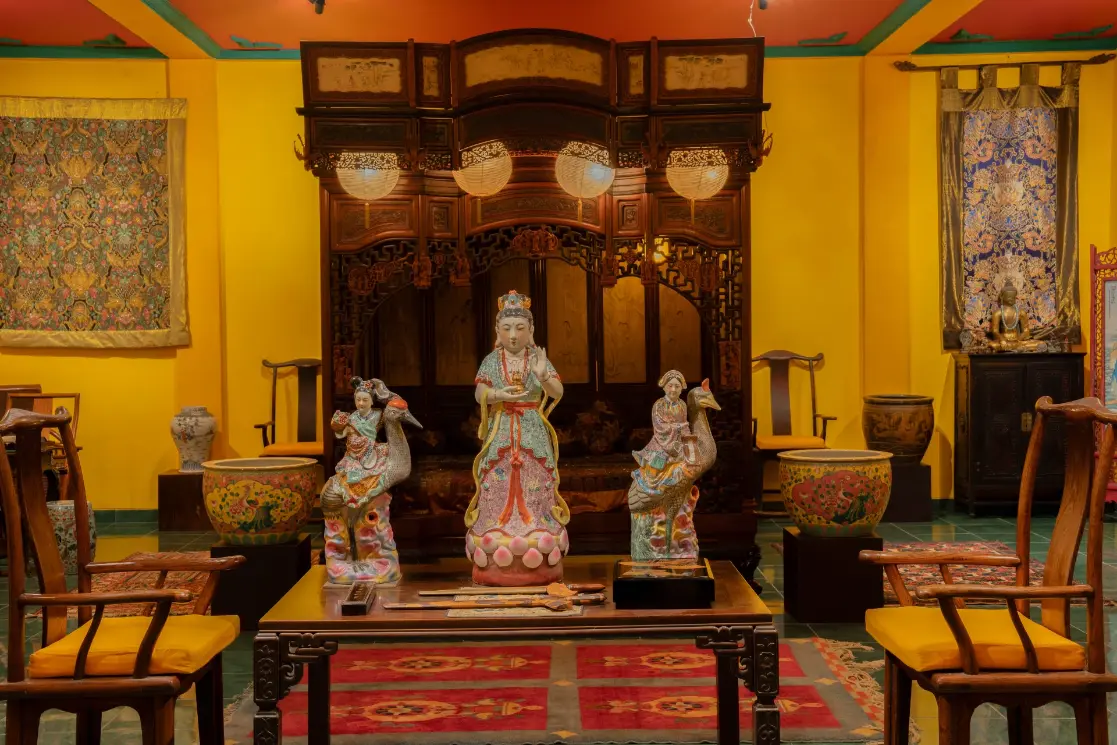
The intricate porcelain statues of Guan Yin, the revered Goddess of Mercy, are far more than mere decorative objects; they are tangible narratives of profound spiritual devotion, masterful artistic innovation, and centuries of vibrant cultural exchange that bridged vast distances from dynastic China to the Indonesian archipelago. These captivating figures, imbued with deep historical and religious significance, serve as enduring testaments to human faith and ingenuity, silently narrating tales of transformation, resilience, and connection across time.
At the heart of these porcelain masterpieces lies the story of Guan Yin, one of the most beloved deities in East Asian Buddhism. Her journey from an Indian Bodhisattva to the feminine goddess cherished by millions is a testament to cultural adaptation.
Guan Yin's origins trace back to India, where she was known as Avalokiteshvara, a male Bodhisattva embodying infinite compassion. The name itself, "He who Hears the Cries of the World," perfectly captures his essence. As Buddhism journeyed along the Silk Roads into China around the first century CE, so too did the reverence for Avalokiteshvara. Initially depicted with masculine characteristics, a significant transformation was set to unfold.
Over centuries, Avalokiteshvara underwent a profound "sinicization" within Chinese culture. By the Tang and Song dynasties, the masculine figure had largely evolved into the graceful, maternal Goddess of Mercy we recognize today. This feminization resonated deeply with Chinese sensibilities, where compassion, nurturing, and maternal love were revered qualities often associated with female figures. The popular legend of Princess Miao Shan, who sacrificed herself to save her father, powerfully cemented Guan Yin's identity as a benevolent female deity, making her an accessible and empathetic figure for common people seeking solace and protection.
The connection between Guan Yin's popularity and various Chinese dynasties is notable. During the Yuan Dynasty (1271-1368 M), founded by the Mongol conquerors, there was significant imperial patronage of Buddhism, particularly Tibetan Buddhism. While this era didn't initiate Guan Yin's feminization (that largely occurred earlier), it certainly solidified her widespread acceptance and fueled the production of diverse Buddhist art. The Yuan period saw continued artistic development in ceramics, setting the stage for the exquisite porcelain works that would become synonymous with Guan Yin in later Ming and Qing dynasties. These statues, often depicting her in flowing robes, holding a vase of pure water or a willow branch, became central to domestic altars and grand temples alike.
The incredible longevity of these Guan Yin statues is largely attributed to the remarkable material they are crafted from: Chinese porcelain. This ancient art form represents a pinnacle of material science and artistry.
The secret to porcelain's endurance lies in its unique composition and the meticulous manufacturing process. Crafted from a specific blend of kaolin (a fine white clay), feldspar, and quartz, the raw materials are subjected to intense heat. Firing at temperatures between and causes the components to undergo vitrification, transforming them into an incredibly dense, non-porous, and glass-like structure. This process makes porcelain exceptionally hard, resistant to scratches, and virtually impervious to water, humidity, and chemical degradation. Furthermore, the application of a protective glaze adds another layer of durability, preserving colors and making the surface even more robust. Unlike organic materials, porcelain does not attract pests, nor does it decompose, ensuring its survival across millennia if handled with care.
How did these delicate yet durable porcelain Guan Yin statues traverse such vast distances to find their home in Indonesia? The answer lies in two powerful historical forces: maritime trade and human migration.
For over a millennium, the bustling maritime trade routes, often referred to as the "Maritime Silk Road," connected China with Southeast Asia and beyond. Chinese junks laden with precious cargo regularly sailed to the Nusantara archipelago. Among the highly coveted goods were fine Chinese porcelain, silk, and tea. Along with these commercial items, religious artifacts like Guan Yin statues were transported, appealing to local elites, collectors, and early Chinese traders settling abroad. This established a critical channel for the flow of goods and ideas.
The second, and perhaps most significant, factor was the continuous wave of Chinese migration to Southeast Asia, particularly from the Ming and Qing dynasties onward. Seeking new opportunities or fleeing turmoil, these communities brought with them not just their entrepreneurial spirit but also their rich cultural and religious traditions. Guan Yin, as a figure of comfort and protection, was central to their faith. To maintain their spiritual practices in their new homeland, they established temples (klenteng) and family altars, requiring sacred objects like porcelain Guan Yin statues. These were either imported through existing trade networks or, in later periods, commissioned directly, cementing Guan Yin's presence in Indonesia as both an icon of faith and a masterpiece of foreign artistry.
From her origins as an Indian Bodhisattva to her revered status as the feminine Goddess of Mercy, and from the sophisticated kilns of ancient China to the bustling port cities of Indonesia, the story of Guan Yin and her porcelain effigies is one of profound cultural fusion and enduring artistry. Each statue encapsulates layers of history, faith, and the remarkable journey of objects that defy the passage of time. To truly appreciate these relics firsthand, understanding their intricate narratives, one is invited to experience them up close.