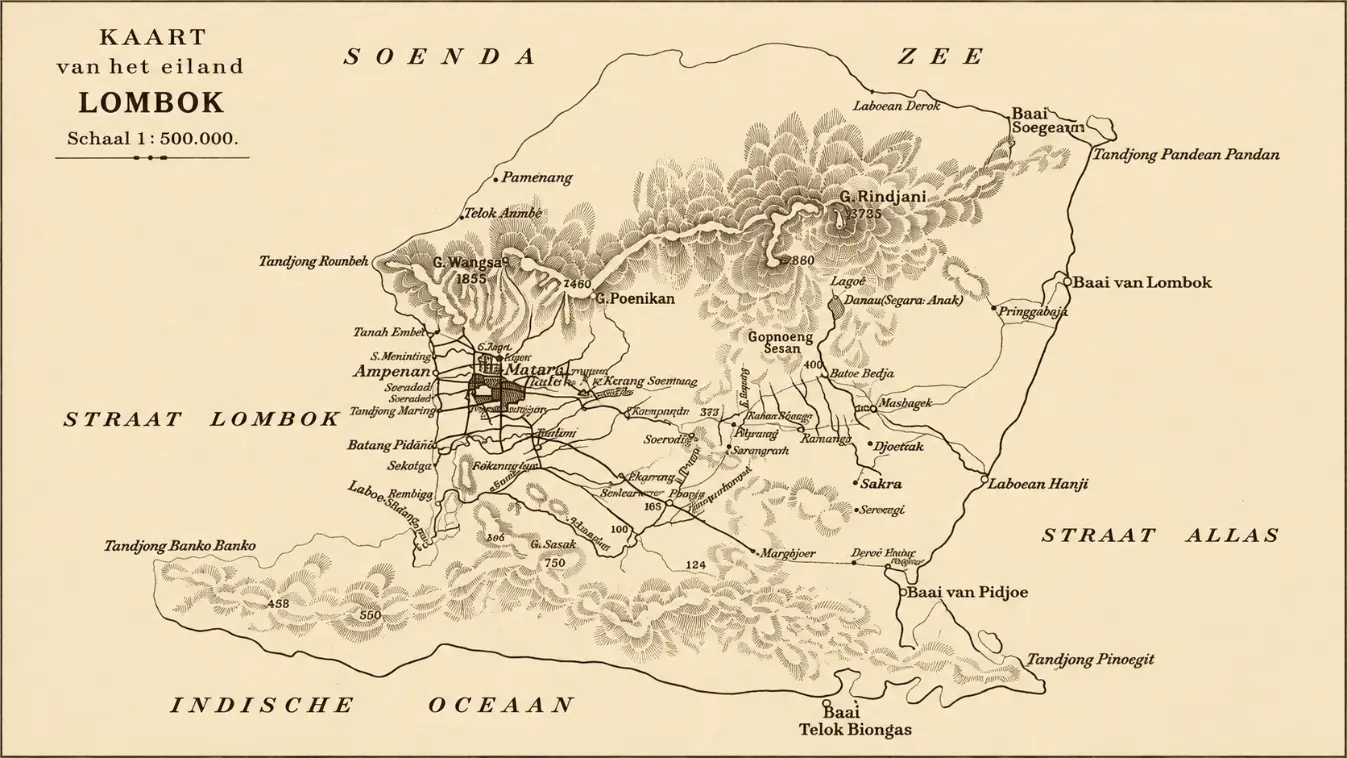
Mads Lange and George Peacock King helped expand Ampenan’s rice trade into Asian and European markets before becoming involved in Lombok’s 1838 to 1839 dynastic war. Their ships and ties with local rulers gave them influence beyond commerce. Mataram’s victory changed the island’s political balance, while the farmers whose rice sustained exports remained under royal authority. Their story shows how international trade could reshape Lombok’s economy and politics.
In the 1830s, Lombok was not an isolated island waiting for Europeans to introduce trade. Its rice-growing districts supplied a busy network of local and regional exchange. Ampenan, on the west coast, became an important port where rice and goods from nearby islands were gathered before being shipped to Singapore, China and Australia. Chinese and Bugis traders were part of this maritime system, alongside European vessels.
Historical reports cited by historian Henk Schulte Nordholt estimate annual rice exports at around 10,000 to 14,000 tonnes. In 1835, fifteen English and three French vessels were reportedly seen off Ampenan at the same time. These figures indicate the port’s activity, but they do not mean every farmer traded directly with European merchants. Lombok’s export economy depended on local producers, regional traders, port intermediaries and rulers who controlled access to trade.
Mads Lange, a Danish trader working with the Burd partnership, was based in Ampenan from 1834. His business gathered rice from Lombok’s hinterland and connected it with overseas buyers. George Peacock King, an English merchant and former partner in a Batavia trading house, also settled in Ampenan in 1834, with commercial connections mainly through Singapore.
At first, there was room for both men. They promoted Lombok rice to overseas markets and helped attract more ships to Ampenan. Yet neither operated independently of local power. Both depended on protection from the Karangasem-Lombok ruling group, while the royal elite received payments and other benefits in return for access and protection.
This arrangement shaped who benefited from trade. Overseas demand created a larger market for rice, but political authority influenced the terms of exchange. Merchants needed access to the port and agricultural hinterland, while rulers gained revenue and influence from controlling that access. Local farmers and traders supplied the economic foundation, although surviving accounts say more about merchant profits and royal payments than ordinary household earnings.
In early 1838, a struggle broke out between the Karangasem-Lombok and Mataram ruling houses. This was an internal contest for political supremacy, not simply a war between Lombok’s residents and foreign merchants. The dispute reflected the competing ambitions of two established royal houses.
King chose to support Mataram, which Nordholt describes as the weaker side at the beginning of the conflict. Lange initially expected Karangasem-Lombok, the group that protected him, to prevail. Yet King helped transport troops from Bali for Mataram, and Lange also joined the transport despite acting against his own protector. Both became more involved as their trade, protection and credit in the rice-growing hinterland came under threat.
Their role did not create the dynastic dispute, but their shipping connections helped change its balance. The war continued until the middle of 1839 and ended in victory for Mataram. Nordholt argues that the troops transported from Bali by King and Lange contributed decisively to that outcome. Mataram then held hegemony over Lombok until Dutch forces destroyed its power in 1894.
The consequences were immediate for both merchants. King was rewarded with the office of syahbandar, a senior port official, and a privileged position in the rice trade. He also became the ruler’s principal adviser on relations with the Dutch. His commercial position had become political influence.
Lange suffered the opposite outcome. He lost his trading establishment, most of his ships and around 30,000 Spanish dollars tied to the defeated Karangasem-Lombok network. He escaped aboard the schooner Venus and left Lombok for Kuta in Bali, where he later rebuilt his business.
For Lombok, the larger change was the consolidation of Mataram’s power. The conflict reshaped who controlled the island, while port trade remained closely tied to merchants and political elites. Research on Sasak society describes a rice-based economy and a political structure in which rulers and officials benefited from their positions. It cites an estimate of about 400,000 Sasak residents in 1838, not a modern census figure.
The sources do not show exactly how the war affected every village or household. They do show that Lombok’s rice economy was linked to wider markets, royal protection shaped commercial opportunity, and foreign merchants influenced a local power struggle. Global trade and local politics were closely connected, with consequences that outlasted the merchants’ rivalry.
For readers interested in Mads Lange’s life, trading career, and historical legacy in Bali, further information is available on the Mads Lange page at Museum PBC. The page provides an additional resource for understanding the Danish trader beyond his involvement in Lombok’s nineteenth-century trade and political conflicts.